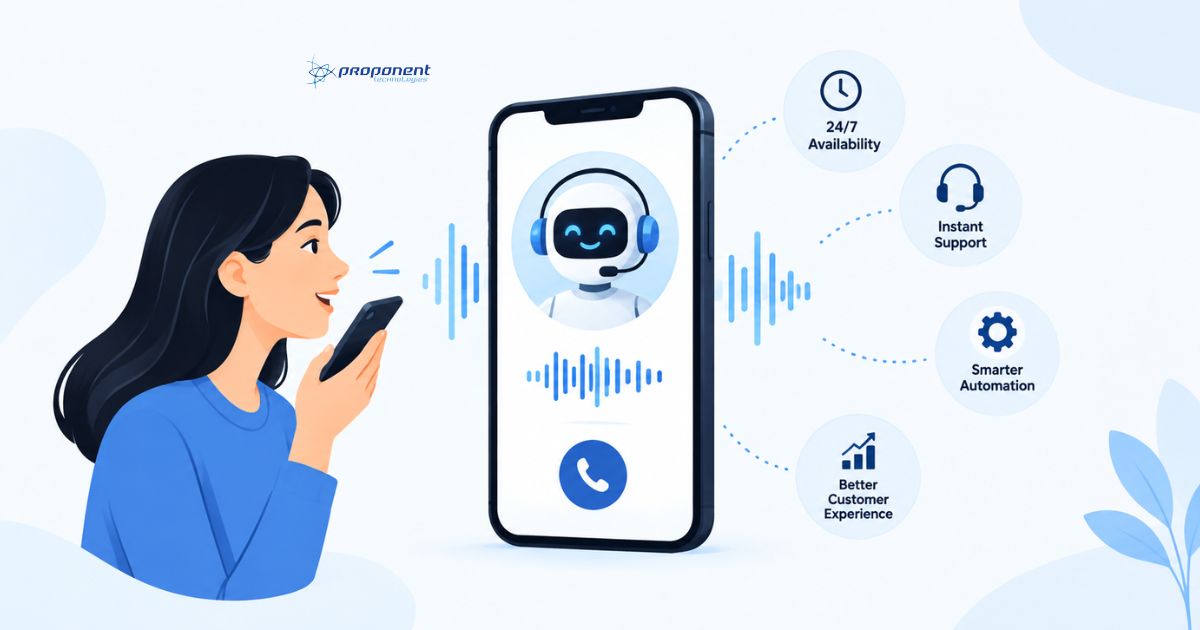
Most AI talk in boardrooms circles around chat windows and copilots. The phone gets ignored, which is odd, because that’s where a customer ends up when something has actually gone wrong. The loan that didn’t disburse. The claim nobody called back about. The parcel marked “delivered” that never showed up. India has well over a billion phone subscribers, and a big chunk of them still pick up the phone before they try an app.
A voice AI agent sits right in that gap. Below: how the thing works under the hood, where it pays off, where it falls flat, and what to check before you sign anything.
What Is a Voice AI Agent?
Put simply, it’s software that answers or makes a phone call, listens, figures out what the person wants, and then does something about it by reaching into your backend systems. A human joins only if the call needs one. Inbound, outbound, both.
Think about the IVR you last swore at. “Press 2 for billing, press 3 to go back.” The caller bends to fit the menu. A voice agent flips that. You say “my EMI got debited twice” and the system works out the rest. Small shift on paper. Completely different experience on the line.
How a Voice AI Agent Works: The Technical Stack
There isn’t one model doing everything. It’s a chain, and the weakest link sets the ceiling.
- Telephony layer: SIP trunks or cloud telephony connect the agent to the phone network. Routing, recording, and DTMF fallback sit here.
- Speech recognition (ASR): Audio goes in, text comes out. Accents, noise, and codec quality all move the accuracy needle. Code-switching too. A caller who opens in Hindi and lands in English mid-sentence is ordinary in India, yet plenty of models choke on it.
- Natural language understanding (NLU) or LLM reasoning: Pulls out the intent and the details (amount, date, policy number) and picks the next step.
- Dialogue management: Remembers what was said three turns back, copes when the caller interrupts, and applies the business rules.
- Integration layer: APIs into CRM, ERP, core banking, scheduling. Skip this, and you’ve built a talking FAQ page.
- Text-to-speech (TTS): The voice callers actually hear. Pacing matters here more than people assume.
Latency Is the Hard Constraint
Two seconds of waiting in a chat box? Nobody notices. Two seconds of silence on a call and the customer says “hello? hello?” Natural speech runs on gaps of a few hundred milliseconds, which means real-time voice AI has to stream at every stage, with recognition, reasoning, and speech output overlapping instead of queuing up. Barge-in is the other trap. If a caller cuts in and the agent keeps talking, that call is basically lost. Test on a mobile network. Office Wi-Fi flatters everything.
Why the Phone Is Where AI Delivers Measurable Impact
Phone traffic is repetitive, more than most teams admit. Pull any contact-centre report and a short list of intents eats most of the volume: order status, balance checks, rescheduling, payment reminders, simple eligibility questions. Bounded, predictable, and pricey to staff.
Voice AI Agents can absorb that load so people spend their time on calls that need real judgement. What changes shows up in numbers finance already tracks:
- Cost per contact drops once routine calls skip the human queue.
- Pickup is immediate, so wait time stops being a complaint.
- Nights, weekends, and Diwali-season spikes get covered without panic hiring.
- Compliance wording gets read the same way on every single call.
One more thing people miss: every call turns into data. Transcripts, intents, sentiment, outcomes. Quality teams that reviewed maybe 2% of calls by hand can now look at all of them.
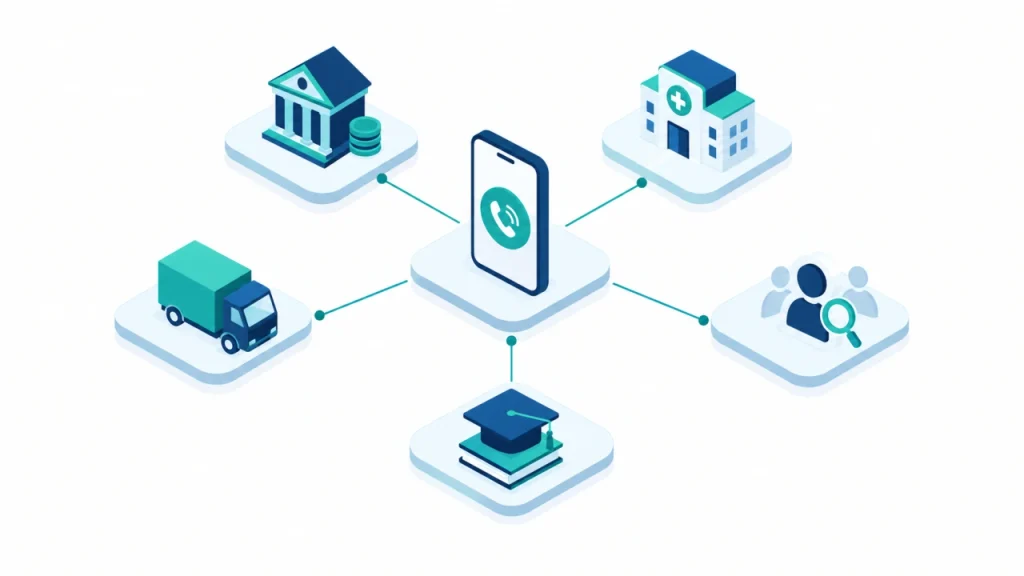
Key Use Cases Across Industries
Banking, Financial Services, and Insurance (BFSI)
EMI reminders, collections follow-ups, KYC status, renewals, loan lead qualification. Collections fit especially well since the calls are scripted, high-volume, and time-bound, and regulatory language can be fixed inside the flow.
Healthcare
Appointment booking and changes, lab report alerts, post-discharge check-ins, vaccination reminders. Hospitals in Ahmedabad, Indore, or Coimbatore often run lean front desks. A voice agent covers the hours nobody’s there.
Logistics and E-commerce
Delivery confirmation, address checks, rescheduling after a failed attempt, COD confirmation. Fixing a wrong address before dispatch can trim return-to-origin numbers noticeably.
Recruitment and EdTech
Candidate screening, interview slots, admission enquiries, fee reminders. Recruiters get a structured summary per candidate rather than a list of missed calls.
Support Operations
Voice AI for Customer Support tends to work when scope follows intent, not department. Take the five to ten intents behind most of your volume, automate those properly, and send everything else to a person with the context attached. Trying to automate the entire support function at launch is how projects stall.
Same story at contact-centre scale. Call Center Automation pays off when the call flows themselves get redesigned, and it usually disappoints when a new layer is bolted onto the old IVR.
Voice AI Agent vs. Traditional IVR
| Factor | Traditional IVR | Voice AI Agent |
| Input | Keypad or fixed keywords | Natural spoken language |
| Flow | Rigid menu tree | Dynamic, context-aware |
| Language support | Usually, one or two | Multilingual, with code-switching |
| Task completion | Mostly routing | End-to-end resolution via APIs |
| Analytics | Basic call logs | Full transcripts, intents, sentiment |
| Update cycle | Reprogramming | Prompt and workflow changes |
Compliance, Security, and Governance in India
Performance is only half of the evaluation. The regulatory half is where Indian rollouts usually hit trouble.
- DPDP Act, 2023: Recordings and transcripts are personal data. Consent, purpose limits, retention rules, and breach reporting all apply.
- TRAI rules: Outbound calling sits under DND checks, calling-hour limits, and telemarketing registration norms. Being automated doesn’t buy an exemption.
- Disclosure: Tell the caller it’s an automated system. Apart from the ethics, complaints go down.
- Sector rules: BFSI and healthcare have separate demands on data localisation, call recording, and audit trails.
- Security: Encryption at rest and in transit, role-based access to transcripts, PII redaction, vendor audit reports. Not negotiable.
Ask vendors where data is processed and stored, who can open recordings, and how a deletion request gets handled. If the answer is vague, treat that as the answer.
What to Evaluate Before You Deploy
- Language and accent accuracy. Feed it your own call recordings, not the vendor’s polished demo. Include Hindi, Gujarati, Tamil, or whatever your customers really speak.
- End-to-end latency. Measure on a live call over a mobile network.
- Integration depth. Can it read and write to your systems, or only answer questions?
- Escalation design. How does the handoff to a human work? Does the context travel with the call?
- Guardrails. Look for controls against invented answers, topic drift, and promises the business never approved.
- Reporting. You want visibility into containment, escalation reasons, and where calls fail.
- Pilot structure. One or two intents to begin with, and a success threshold agreed before launch.
Limitations Worth Acknowledging
No, a voice AI agent won’t replace your whole team. Noisy lines, patchy networks, and heavy regional dialects still hurt recognition. Emotional calls (a bereavement, a fraud dispute, a scary medical question) need a human. So do tangled negotiations and strange edge cases.
Containment rate, meaning the share of calls resolved with no human involved, is handy but can mislead. A high figure may include people who just hung up. Read it next to resolution quality, repeat-call rate, and satisfaction scores.
Conclusion
The phone is where enterprise AI meets customers live, under pressure, with nowhere to hide a mistake. Tough test, worthwhile one. Companies that scope tightly, test with real audio, and build compliance in from day one will see the strongest returns. Those expecting plug-and-play won’t.
Frequently Asked Questions
What is a voice AI agent?
An AI system that holds spoken conversations over phone calls, understands the request, and completes the task through connections to business systems.
How is it different from a chatbot?
A chatbot handles text. A voice agent deals with speech recognition, instant replies, interruptions, and natural-sounding speech, which makes the engineering much harder.
Can it handle Indian languages?
Yes, though accuracy varies by language, accent, and audio quality. Test on your own call data first.
Is it compliant with Indian data laws?
Depends on the vendor’s architecture and your setup. Check consent capture, retention, and where data is processed against the DPDP Act and your sector’s rules.
How long does implementation take?
A focused pilot on a few intents can be live in weeks. Full rollout depends on how complex your integrations are and how fast approvals move.
Which calls should stay with humans?
Sensitive, emotional, high-value, or legally tricky ones.