Career
How No-Code Voice AI Reduces Time-to-Value for Enterprise Teams
Discover how no-code Voice AI platforms help enterprises deploy faster, reduce implementation costs, and accelerate business value without coding.
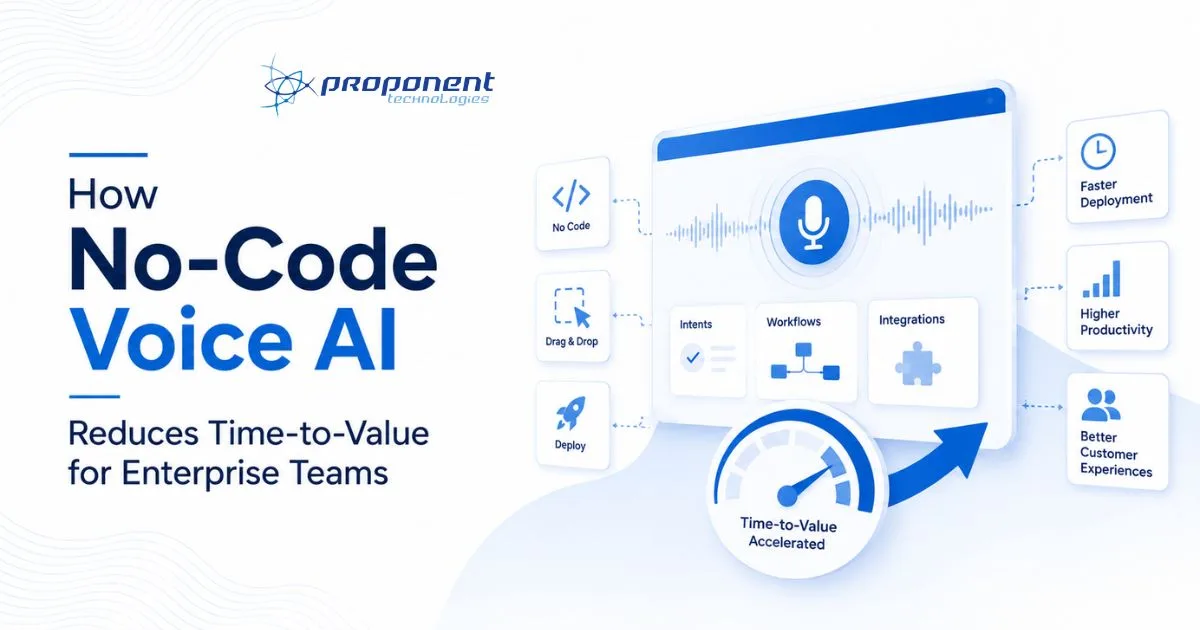
Table of ContentsShow or hide
Enterprise teams are under constant pressure to ship customer-facing automation faster, without waiting months for engineering bandwidth. This is exactly where a Voice AI Platform built for no-code deployment changes the calculus. Instead of writing custom integrations, training in-house NLP models, or waiting on a developer queue, business and operations teams can configure, test, and launch voice automation themselves — cutting time-to-value from quarters to weeks.
This shift matters because voice is still the channel customers default to for anything urgent, sensitive, or complex. A Voice AI Customer Service Agent that can be configured without code means support, sales, and operations leaders no longer have to choose between speed and control. They can iterate on call flows the same way they’d edit a spreadsheet and see the results the same week.
For enterprises operating across regions, the calculation gets even more compelling. A no-code Multilingual Voice AI layer means a single platform can serve customers in their preferred language without a parallel build for every locale — removing one of the highest hidden costs of scaling voice support internationally.
What is a No-Code Voice AI Platform?
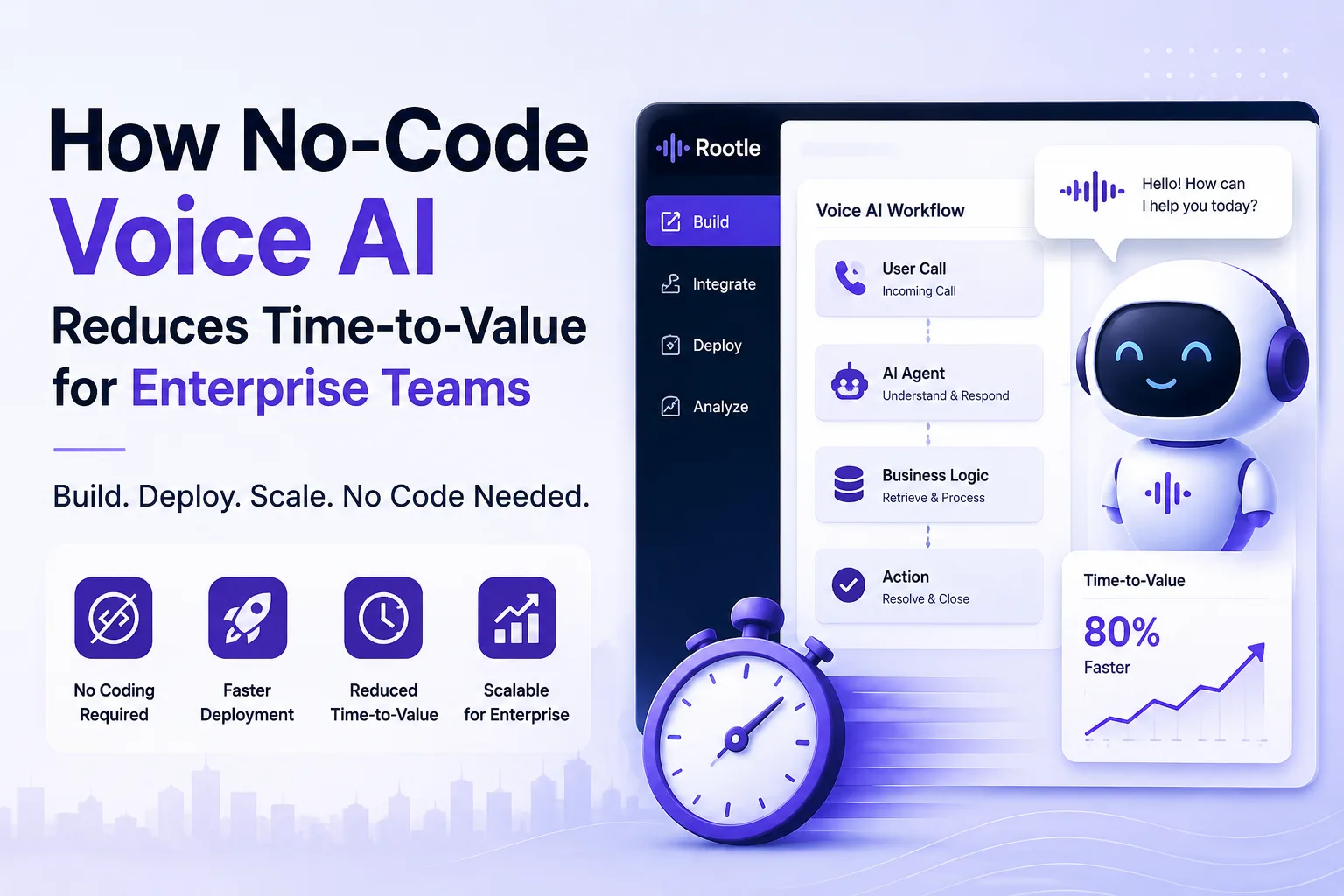
A no-code voice AI platform is software that lets non-technical teams design, configure, and deploy automated voice interactions — call routing, FAQ handling, appointment booking, and order status checks – through a visual interface rather than custom code. Instead of engineers writing speech-recognition pipelines and dialogue trees from scratch, business users assemble prebuilt conversation blocks, connect them to existing systems such as a CRM or ticketing tool, and publish changes instantly.
The ‘no-code’ label doesn’t mean the underlying technology is simple. Modern platforms still rely on advanced speech-to-text, intent recognition, and natural language generation. What changes is who gets to operate that technology. A contact centre manager, not a developer, becomes the person who edits a call script or adds a new self-service flow.
This matters most at the point where a call needs to move from automation to a person. A platform built on no-code logic still has to decide, in real time, when a caller’s intent falls outside what the bot can resolve and hand off cleanly with the right context attached. Getting that handoff right is often what separates a pilot that gets shut down from one that earns a wider rollout.
Benefits of No-Code Voice AI
The most immediate benefit is speed. Traditional IVR and voicebot projects often take months to scope, build, and test, largely because every change requires a development cycle. No-code platforms compress this by letting teams configure and test changes directly, often the same day they’re requested.
Cost is the second major advantage. Removing the dependency on dedicated engineering resources for every iteration lowers both the upfront build cost and the ongoing maintenance burden. Teams can run more experiments — testing different greetings, escalation rules, or self-service options — without each test consuming developer hours.
There’s also a resilience benefit that’s easy to overlook. When voice automation logic lives in a visual builder instead of being buried in code, institutional knowledge isn’t lost when a developer leaves the team. Business teams can see exactly how a call flow works, audit it, and adjust it as policies or products change.
Finally, no-code platforms tend to shorten the feedback loop between customer behaviour and platform improvement. If call data shows customers frequently asking about a topic the bot doesn’t handle well, an operations lead can add that capability directly, without filing a ticket and waiting in a backlog.
These gains compound as adoption grows. A team that launches one use case in week one and a second in week three is building organisational muscle, not just a single automation. Over a few quarters, that muscle shows up as measurable reductions in average handle time, first-call resolution gaps, and the number of calls that needed a human at all – metrics leadership can track without relying on engineering for every data point.
Why Enterprises Need a Voice AI Platform
Call volumes for most enterprises don’t grow in a straight line, they spike around product launches, billing cycles, outages, and seasonal demand. Hiring and training human agents to absorb every spike is expensive and slow, and over-staffing for peak demand wastes budget the rest of the year. Voice automation absorbs that variability without the lead time of recruitment.
There’s also a consistency argument. Human agents vary in tone, accuracy, and adherence to policy, especially under high call volume or staff turnover. A well-configured voice AI platform applies the same logic and the same compliance language on every call, which matters in regulated industries where a single inconsistent disclosure can create real liability.
Perhaps most importantly, enterprises need a platform, not a one-off bot, because voice automation needs are rarely static. New products, new regions, new compliance requirements, and new integrations all require the underlying system to be flexible. A platform approach means each new requirement is a configuration change rather than a new project.
Budget predictability is the often-underrated reason enterprises move toward a platform model. A custom-built voicebot carries an unpredictable cost curve: every new requirement triggers a new development estimate. A configurable platform converts most of that ongoing cost into a known, recurring line item, which makes it far easier for finance and operations leaders to plan a multi-year automation roadmap instead of approving one project at a time.
Rootle’s Approach to Voice AI Automation
Rootle is built around the idea that voice automation should be something operations and support teams can own directly, rather than something they request and wait for. The platform is designed so that call flows, escalation logic, and integrations with existing business systems can be configured visually, with changes reflected immediately rather than after a release cycle.
This design choice has a direct effect on time-to-value. Enterprises evaluating voice automation typically want to see results from a pilot within weeks, not quarters. Because Rootle removes the custom-development step from the deployment process, teams can launch an initial use case, such as appointment confirmations or tier-one support deflection, quickly, measure the impact on call volume and resolution time, and expand from there based on real data rather than projected ROI.
Equally important is what happens after launch. A platform that’s easy to deploy but hard to adjust just shifts the bottleneck downstream. Rootle’s approach keeps the same no-code configuration model available for ongoing iteration, so the team that launched the first use case is also the team that can refine it, add new languages, or extend it to new departments as adoption grows.
This also keeps governance in the hands of the people accountable for the customer experience. Because changes are made through a visual configuration layer rather than buried in code, compliance and quality teams can review exactly what a call flow does and approve changes before they go live, rather than relying on a developer’s documentation after the fact.
For enterprises weighing build-versus-buy decisions on voice automation, the practical question isn’t just which platform has the most features; it’s which platform lets the team closest to the customer make changes without waiting in line. That’s the gap a no-code voice AI platform is built to close, and it’s the reason time-to-value, not just feature breadth, should be at the centre of the evaluation.