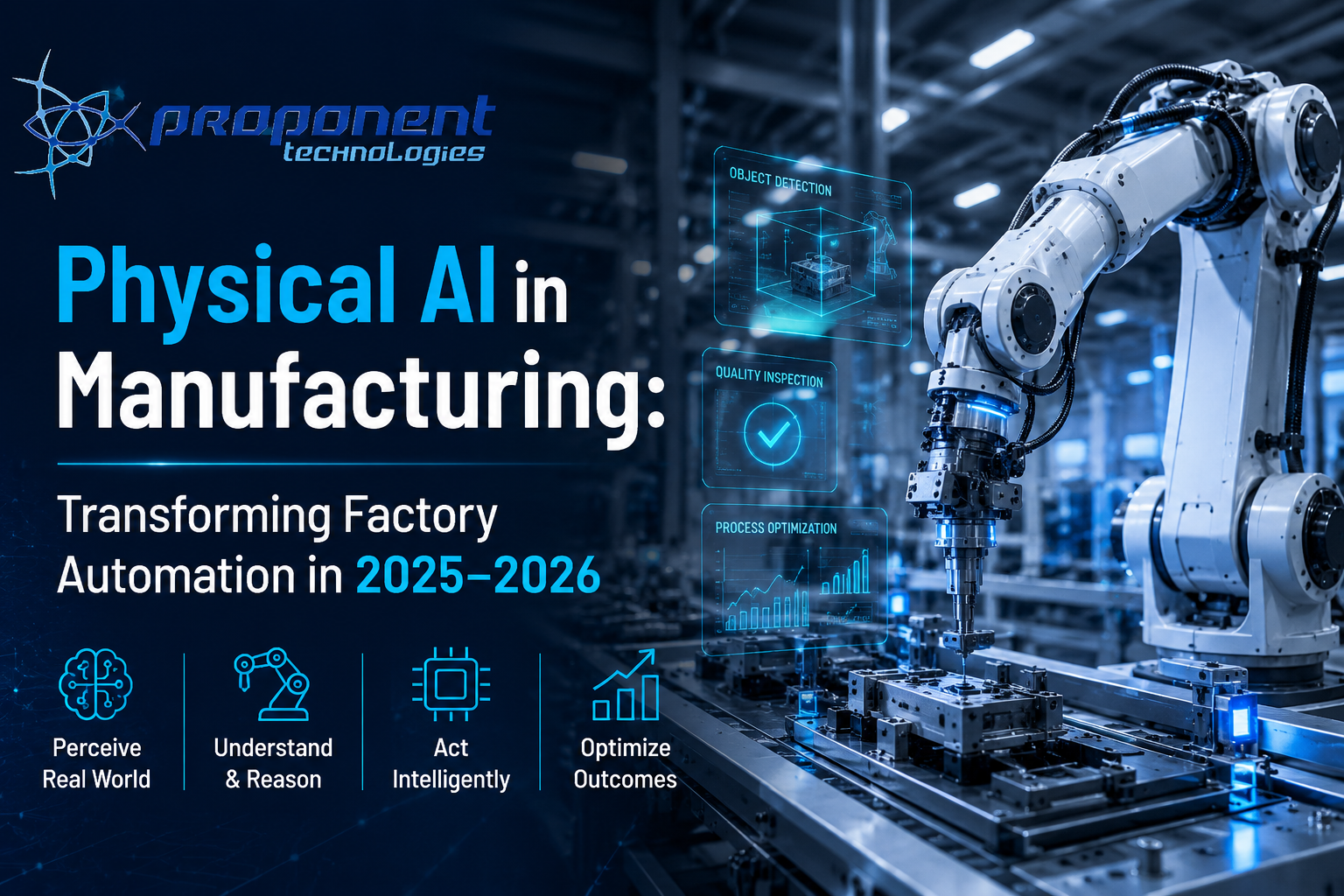
The factory floor is undergoing its biggest transformation in decades. Machines that once needed constant human supervision can now perceive their surroundings, make real-time decisions, and adapt to unexpected changes, all on their own. This is the promise of Physical AI in manufacturing, and it is no longer a future concept. It is happening right now, reshaping industries across the globe.
Physical AI refers to artificial intelligence that is embedded directly into physical systems, robots, industrial equipment, autonomous vehicles, and smart machinery — enabling them to sense the real world, understand it, and take intelligent action. Unlike traditional automation, which follows rigid, pre-programmed instructions, Physical AI systems learn from their environment and continuously improve their performance over time.
As NVIDIA CEO Jensen Huang declared at CES 2026, “The ChatGPT moment for Physical AI is here.” That statement signals something important: we are at an inflection point where Physical AI is moving from research labs and pilot programs into full-scale commercial deployment on factory floors worldwide.
In this article, we explore what Physical AI means for the manufacturing industry, why adoption is accelerating so rapidly, the most impactful use cases delivering real ROI, and how manufacturers can begin their journey today.

What Is Physical AI — And Why Does It Matter for Manufacturing?
To understand why Physical AI is such a big deal, it helps to contrast it with what came before.
Traditional industrial automation is powerful but limited. A robotic arm on an assembly line can perform the same welding task thousands of times without error — but only if every condition remains exactly the same. Change the part slightly, adjust the lighting, or introduce an unexpected obstacle, and the system breaks down.
Physical AI removes that limitation. It combines computer vision, machine learning, reinforcement learning, multimodal AI models, and edge computing to give machines a genuine understanding of their environment. A Physical AI-powered robot does not just detect a defective part — it understands the nature of the defect, determines the appropriate response, and learns from each instance to make better decisions in the future.
This shift from rule-based automation to intelligent, adaptive systems is what makes Physical AI so transformative. It is the difference between a machine that can only do what it was told and a machine that can figure out what needs to be done.
The Market Opportunity: Numbers That Tell the Story
The scale of investment flowing into Physical AI reflects how seriously the global business community is taking this technology.
The Physical AI market, valued at approximately USD 5.23 billion in 2025, is projected to reach USD 49.73 billion by 2033, growing at a compound annual growth rate of 32.53%. Manufacturing is at the center of this expansion, with industrial robotics serving as the primary proving ground.
Global industrial robot installations reached 542,000 units in 2024, more than double the figure from a decade ago and the second-highest annual installation count in history. Annual deployments are expected to surpass 700,000 units by 2028, with Asia accounting for 74% of current installations, followed by Europe at 16% and the Americas at 9%.
A Deloitte report published in March 2026 found that while only 5% of manufacturers currently describe Physical AI as transforming their organisation, 41% expect it to do so within the next three years. A survey by the Manufacturing Leadership Council found that nearly one in four manufacturers plans to use Physical AI within two years — more than double the current adoption rate of 9%.
These numbers point to one clear conclusion: Physical AI is moving from early adopter territory to mainstream manufacturing strategy, and the window for first-mover advantage is closing.

6 Real-World Use Cases Delivering Results Today
Physical AI is not theoretical. These are the applications already generating measurable value across manufacturing operations globally.
1. Predictive Maintenance
One of the highest-ROI applications of Physical AI is predictive maintenance. AI systems analyze sensor data from motors, bearings, spindles, and other critical equipment to forecast failures 4 to 8 weeks before they occur. This eliminates unplanned downtime, extends asset life, and dramatically reduces repair costs.
Companies that have implemented AI-driven predictive maintenance report an average 10:1 return on investment within two years, according to Deloitte research. Machine downtime can be reduced by up to 50%, delivering a direct and measurable impact on production output.
2. AI-Powered Quality Inspection
Traditional visual inspection on the production line is slow, inconsistent, and limited by human capability. Physical AI changes this entirely. Computer vision systems can detect defects as small as 0.1mm with accuracy that exceeds human inspectors, while inspecting more than 1,000 units per minute.
These systems catch microscopic flaws that would otherwise make it into finished products, reducing warranty claims, recalls, and customer complaints. The ROI on AI quality inspection is estimated at around 250%, making it one of the most compelling investments in smart manufacturing.
3. Collaborative Robots (Cobots)
AI-enabled collaborative robots — or cobots — are designed to work safely alongside human workers without the need for physical safety barriers. They handle repetitive, physically demanding, or hazardous tasks while freeing human workers to focus on higher-value activities.
In 2025 and 2026, 70% of collaborative robot orders came from non-automotive sectors, demonstrating how broadly this technology is spreading beyond its traditional stronghold. Cobots reduce worker injury rates, improve consistency, and boost throughput — often paying for themselves within one to two years.
4. Autonomous Mobile Robots (AMRs) for Internal Logistics
Physical AI powers the next generation of autonomous mobile robots that navigate factory floors without fixed tracks or pre-set paths. These AMRs handle material transport, parts delivery, sorting, and inventory management dynamically — rerouting in real time when their environment changes.
The logistics sector is projected to grow at a 14.2% CAGR through 2029, driven significantly by autonomous robotic systems. For manufacturers, AMRs reduce bottlenecks in material flow and allow human workers to be redeployed to tasks that require judgment and dexterity.
5. Digital Twins for Simulation and Optimisation
Digital twins — virtual replicas of physical factory assets and processes — allow manufacturers to simulate production scenarios, test process changes, and optimise workflows without ever disrupting live operations. Before deploying a new production line configuration, a digital twin can be used to model thousands of scenarios and identify the optimal setup.
This capability reduces the cost and time of production changes dramatically, and is increasingly used for training AI models in simulated environments before they are deployed on real hardware.
6. Self-Optimising Production Scheduling
AI agents now monitor production data continuously and adjust scheduling in real time — rerouting jobs when machines go offline, balancing energy loads to reduce costs, and tuning machine parameters to maximise output. Unlike static scheduling systems, these agents adapt dynamically to disruptions without requiring human intervention.
Manufacturers implementing AI-driven production scheduling report productivity gains of up to 30%, with reductions in idle time and improved overall equipment effectiveness (OEE).
Why Is Physical AI Adoption Accelerating Right Now?
Several powerful forces are converging to make 2025 and 2026 a tipping point for Physical AI in manufacturing.
Rising labour costs and falling robot costs. Average U.S. hourly manufacturing wages reached $34 in 2025 and are expected to climb to $39 by the end of the decade. At the same time, industrial robot costs continue to decline while capabilities improve. This widening gap is tilting the economic argument firmly in favour of automation.
Reshoring and supply chain resilience. The disruptions of recent years accelerated the movement to bring manufacturing back to the U.S., Europe, and other advanced economies. Physical AI makes this economically viable by allowing factories in higher-cost regions to compete on productivity rather than labour costs alone. Strategic sectors, including semiconductors, electric vehicles, and pharmaceuticals, are leading this investment wave.
Breakthroughs in AI capability. Advances in computer vision, reinforcement learning, large language models, and edge AI hardware have rapidly closed the gap between what robots can do in controlled environments and what they can do in the messy, dynamic reality of a working factory. Next-generation edge AI chips are expected to reduce latency in physical systems by up to 60%, enabling faster and safer real-time decision-making.
Workforce transformation pressure. Labour shortages in manufacturing are persistent and worsening in many markets. Physical AI offers a path to maintaining output and quality with a smaller — but more skilled — workforce. As the World Economic Forum notes, this represents a transition of roles rather than simple elimination: machine operators become robot technicians, maintenance teams shift to predictive maintenance specialists, and engineers focus on training and optimising AI systems.
Key Challenges to Plan For
Adopting Physical AI at scale is not without its obstacles, and manufacturers who approach this strategically will be better positioned than those who rush in without preparation.
Cybersecurity is a growing concern. Manufacturing has been the most targeted industry for ransomware and cyberattacks for four consecutive years, according to IBM’s X-Force 2025 Threat Intelligence Index. As more systems become connected and AI-enabled, the attack surface expands. The 2025 cyberattack on Jaguar Land Rover halted global production for five weeks and cost an estimated $260 million — a sobering reminder that automation investments must be paired with robust security strategies.
Engineering talent remains scarce. Physical AI deployments require specialists in robotics, AI model development, edge computing, and IT/OT integration — a profile that is in short supply worldwide. Building internal capability through training and strategic hiring must be treated as a parallel priority to technology investment.
Data infrastructure must come first. AI systems deliver value only when they have access to clean, consistent, and well-structured data. Manufacturers who have not yet built solid IIoT sensor networks, integrated their MES and ERP systems, and established data governance frameworks will need to address these foundations before advanced AI applications can deliver their full potential.
The ROI Case: What Manufacturers Are Actually Achieving
For businesses making the investment decision, the return data is strong across every major Physical AI application:
- Predictive maintenance: 250–300% ROI, 50% reduction in unplanned downtime
- Robotics and automation: 275–300% ROI
- AI quality inspection: approximately 250% ROI
- Supply chain optimisation: 220–250% ROI
- Overall productivity: up to 30% improvement with smart factory technologies
- Operational efficiency: robots integrating AI deliver up to 40% higher efficiency versus traditional, non-AI automation systems
These are not aspirational projections. They are reported outcomes from manufacturers at Siemens, Bosch, GE, and thousands of mid-sized industrial companies that have moved from pilot programmes to full production deployment.
A Practical Roadmap: How to Get Started
Industry experts consistently recommend a phased approach that builds capability and confidence incrementally, rather than attempting a wholesale transformation all at once.
Phase 1 — Establish your data foundation. Deploy IoT sensors on critical equipment. Start with high-value, high-risk assets such as pumps, motors, compressors, and CNC machines. This delivers immediate value through condition monitoring and begins generating the data your AI systems will need.
Phase 2 — Apply AI to proven use cases. Implement predictive maintenance and AI-powered quality inspection. These applications have the clearest ROI and the fastest payback periods, and they build the organisational confidence and technical capability needed for more complex deployments.
Phase 3 — Automate physical workflows. Introduce cobots for assembly support and AMRs for material handling and internal logistics. At this stage, invest equally in workforce training — the human element of Physical AI adoption is just as important as the technology itself.
Phase 4 — Build the intelligent factory. Implement digital twins, AI-agent-driven production scheduling, and fully integrated smart factory systems. At this level, your facility becomes truly adaptive — continuously learning from operational data and optimising itself in real time.
Conclusion
Physical AI in manufacturing is no longer a trend on the horizon — it is a competitive reality today. The companies investing now are not just improving efficiency; they are building the operational foundations that will define industry leadership for the next decade. Early movers are already establishing advantages in productivity, quality, and cost that will be very difficult for late adopters to catch up to.
Whether you manufacture automotive components, consumer electronics, industrial machinery, or consumer goods, the strategic question has shifted. It is no longer whether to adopt Physical AI — it is how quickly and where to start.
At Proponent Technologies, we work with businesses to design and build the software and technology solutions that make this transition successful. From custom AI integrations and automation platforms to smart factory software and IoT-connected systems, our team brings the technical expertise and strategic insight to help you move from concept to deployment with confidence.